





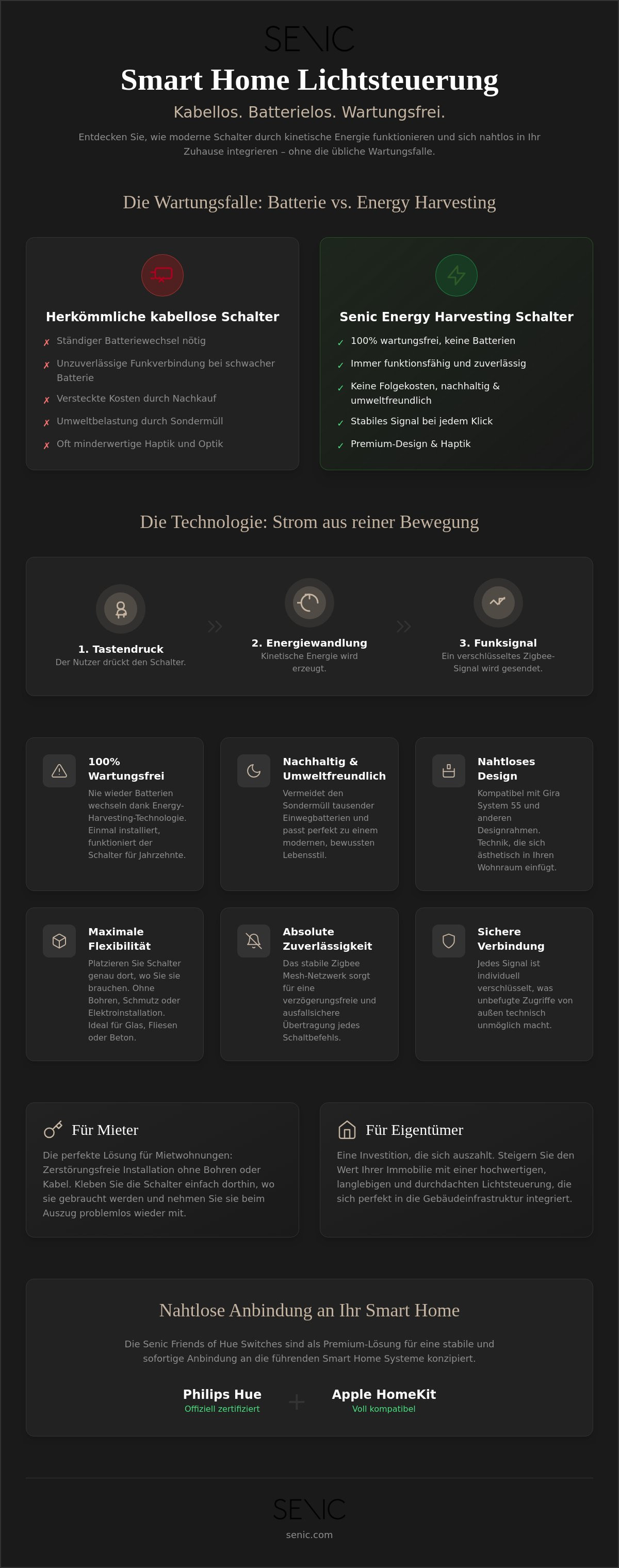
True freedom in a smart home doesn't just mean doing without wires; it also means independence from batteries through kinetic energy. Many homeowners opt for wireless smart home lighting control, only to later discover they're stuck in a constant maintenance trap of battery changes and unreliable wireless connections. This is neither sustainable nor does it meet a modern premium standard. A smart home should take work off your hands, not create new tasks.
Surely you share the desire for a solution that simply works and is aesthetically pleasing. No one wants to see cheap plastic housings on a carefully designed wall. In this guide, you will learn how to control your lighting intelligently without cables, batteries, or any maintenance, and integrate it seamlessly into your design concept. We'll show you how technology impresses through simplicity and durability, without ever demanding your attention.
In addition to smart control, the right lighting provides the crucial feel-good factor; here you can discover Ergovanta and choose high-quality luminaires for your home.
We give you a compact overview of the advantages of energy harvesting, seamless integration into Philips Hue or Apple HomeKit, and explain why compatibility with the Gira System 55 creates the ideal bridge between state-of-the-art function and timeless design.
Key Takeaways
- Avoid the maintenance trap of battery-powered switches and rely on sustainable energy-harvesting technology for lasting reliability.
- Learn how modern wireless smart home lighting control works solely through the kinetic energy of a button press.
- Seamlessly integrate your control into high-quality design frames to perfectly combine technology and aesthetics in your living space.
- Optimize your lighting concept by flexible placement of switches without drilling, dirt, or complex electrical installations.
- Use Senic Friends of Hue Switches as a maintenance-free premium solution for stable and instant connection to Philips Hue and Apple HomeKit.
Table of Contents
- Why "wireless" in lighting control is often a maintenance trap
- The technology behind battery-free wireless light switches
- Design Integration: Gira System 55 and Aesthetics in the Smart Home
- Planning Aid: How to Upgrade Your Home Without Drilling
- Senic Switches: The Maintenance-Free Solution for Philips Hue and HomeKit
Why "wireless" in lighting control is often a maintenance trap
The term "wireless" suggests freedom. In reality, a conventional wireless smart home lighting control often only means that you have shifted the work from wall mounting to buying batteries. A truly wireless solution not only does without wall conduits but also without dependence on external energy sources. Anyone who still relies on batteries today is already planning for tomorrow's frustration. It's a technical step backward to burden a smart system with manual maintenance cycles.
In 2026, maintenance-free operation is the new standard for sophisticated living concepts. It's about absolute reliability. A light switch must work. Always. Without exception. If the wireless connection breaks or the button cell battery voltage drops, the smart home loses its utility. Modern systems today use signals that are transmitted stably and without delay. The energy for this comes directly from user interaction, making the technology invisible and efficient.
The Problem with Power Supply in the Smart Home
Batteries are the weak point of any automation chain. They usually fail exactly when you need them. Besides unreliability, environmental impact is a crucial factor. Thousands of disposable batteries end up in special waste annually, just to enable simple switching commands. This doesn't fit a modern, sustainable lifestyle. Modern technology behind battery-free wireless light switches instead uses kinetic energy. A single button press is enough to generate enough power for a stable radio signal. This is efficient, clean, and permanently reliable. Seemingly inexpensive battery-operated switches become a hidden cost trap in the long run due to constant repurchases and the time spent replacing them. Quality pays off here over years.
Wireless Retrofitting: Tenants vs. Owners
For tenants, non-destructive installation is key to success. No holes in the tiles, no dust, and no discussions with the landlord upon moving out. The switches are simply glued where they are needed. This allows for enormous flexibility in everyday life. Switches can be placed exactly where they were previously missing, for example, directly next to the sofa or on the glass front to the balcony. Owners, on the other hand, benefit from a real increase in the value of their property. A professional wireless smart home lighting control that works without batteries appears high-quality and well thought out. It is part of a long-lasting building infrastructure. Such solutions integrate seamlessly into existing design lines and last for decades. It is the decision for technology that adapts to people, not the other way around.
The technology behind battery-free wireless light switches
Behind the maintenance-free freedom of modern systems lies precise engineering. High-quality wireless smart home lighting control today is based on the principle of energy harvesting. It's a fascinating process. A simple button press generates exactly the amount of energy needed to send a stable radio signal through the room. This self-sufficiency puts an end to the search for suitable button cells or the annoyance of dead batteries at the most inopportune moment.
The technological basis is modern wireless protocols like Zigbee and Bluetooth Low Energy (BLE). Zigbee, in particular, has established itself as the gold standard. It builds a so-called mesh network. Each permanently installed lamp acts as a repeater, forwarding the signal. The result is enormous range and reliability. Current trends in the smart lighting market clearly show that these cross-manufacturer standards dominate the future of networked living. Security is a top priority. Each signal is individually encrypted, making unauthorized access from outside technically impossible.
Energy Harvesting: Power from Movement
Inside the switch, an electrodynamic energy converter operates. This functions on a similar principle to a bicycle dynamo, but on a microscopic scale. The mechanical pressure of the finger moves a magnetic field within a coil. This ultra-short electrical impulse is sufficient to activate the radio module. The mechanical durability is impressive. Kinetic switches are designed for over 100,000 switching cycles. With normal use, this corresponds to a lifespan of several decades. It's technology that you install once and then forget for the rest of its life.
Compatibility with Philips Hue and Apple HomeKit
The "Friends of Hue" certification is the crucial feature for seamless integration. It guarantees that the switch communicates directly and without delay with the Philips Hue Bridge. The system immediately recognizes the switch as a native control device. This allows complex lighting scenes or automations in Apple HomeKit to be triggered with just one click. Direct coupling offers the advantage of virtually latency-free reaction. The light responds immediately, just like with a classic wired switch. Anyone looking to implement an aesthetic and technically sophisticated wireless smart home lighting control will find the right answer to the highest demands in Senic's Smart Switches. The combination of battery-free technology and high-quality haptics makes the difference noticeable in daily use.
Design Integration: Gira System 55 and Aesthetics in the Smart Home
Design is not a mere detail. It largely determines whether technology harmonizes with a living space or is perceived as a disturbing foreign object. High-quality wireless smart home lighting control must measure up to existing aesthetic standards. Many conventional smart home solutions fail due to bulky plastic housings that cannot compete haptically and visually with classic switch programs. However, an intelligent home should shine through its function, not its visibility.
The Gira System 55 standard forms the ideal ecosystem for this. With a uniform dimension of 55 x 55 mm for all inserts, this system offers almost limitless design freedom. It allows the combination of over 300 functional inserts with various design lines. For 2026, especially clear lines and matte surfaces are trending. Whether timeless pure white or striking matte black; the choice of color follows the trend towards natural, understated nuances that highlight architecture and interior rather than dominating them.
Seamless Look through Standard Dimensions
Integration into existing multi-gang frames is key to a professional appearance. A battery-free switch can be placed directly next to conventional outlets or blind switches without the need to modify flush-mounted boxes. Haptics play a crucial role here. The familiar, rich click of a mechanical switch conveys quality and reliability. It's the tactile feedback that gives users the certainty that their command has been executed. Invisible technology in this context means that the wireless smart home lighting control is visually indistinguishable from the rest of the electrical installation.
Outdoor Solutions: Wireless Control for Garden and Terrace
Smart lighting doesn't end at the patio door. However, in outdoor areas, material requirements are significantly higher. Weatherproof wireless light switches must withstand extreme temperatures, UV radiation, and moisture. This is where specific IP protection classes come into play. An outdoor switch should have at least IP44 protection (splash-proof); for exposed locations, IP65 (jet-proof) is the safer choice.
The application scenarios are diverse. Control garden lighting directly from the barbecue area or activate pool lighting without having to go indoors. Since these switches do not require wiring, they can be flexibly attached to posts, exterior walls, or even garden furniture. The robust design ensures that the technology functions precisely even after years outdoors. It is the perfect extension for a holistic, maintenance-free smart home experience outdoors.
Planning Aid: How to Upgrade Your Home Without Drilling
A smart home should adapt to your life, not the other way around. Installing wireless smart home lighting control today is so uncomplicated that it requires no structural changes whatsoever. This is the decisive advantage for tenants and owners who want to avoid the dirt and costs of a classic electrical installation. The process doesn't begin with a toolbox, but with a precise observation of your daily habits.
Optimal lighting control begins with analyzing daily routines. Walk through your rooms and identify moments when the current switch placement is impractical. Do you have to get up to dim the light from the sofa? Is there no switch right next to the bed? This analysis forms the foundation for a logical and comfortable system that saves you steps instead of creating new ones.
Needs Assessment and Placement
Analyze your walking paths in detail. A switch at the room entrance is standard, but often not enough. Place additional controls where you spend the most time. Thanks to high-quality 3M adhesive pads, battery-free switches can be attached to almost any smooth surface. Glass fronts, kitchen tiles, or the wooden bed frame thus become intelligent interfaces. Installation takes seconds. Since no batteries need to be replaced, the switches can remain permanently in place. Discover the suitable Indoor Sets for your project to start implementing it directly.
- Entrance area: A central switch that turns off all lights when leaving the apartment.
- Living room: Discreet placement on the coffee table for various lighting scenes.
- Bedroom: Dual mounting at the head of the bed for maximum convenience.
Advanced Configuration
After physical placement comes digital setup. You assign functions to the buttons via the Philips Hue App or Apple HomeKit. Modern systems allow multiple assignments. A short click switches a single lamp; a long click activates a complex scene. This way, you control the entire house with just one button.
Senic Switches: The Maintenance-Free Solution for Philips Hue and HomeKit
The Senic Friends of Hue Smart Switches represent the consistent further development of modern wireless smart home lighting control. In a world often characterized by short-lived electronics, this solution relies on durability and precision "Made in Germany." It is not just a gadget; it is a full-fledged component of your home control system. By eliminating batteries, valuable electronic waste is consistently avoided. This protects the environment and your wallet equally. You invest in technology that remains reliable for decades.
Commissioning is designed for maximum efficiency. The switch is ready to go and connected to your system in less than 2 minutes. Thanks to direct integration into the Philips Hue app, complicated programming is completely eliminated. You simply stick the switch to the wall, pair it via the app, and assign your desired lighting scenes. Entering professional lighting control couldn't be simpler. It's the ideal solution for anyone seeking perfection without compromise on installation effort.
Why Senic is the Best Choice for Philips Hue Users
The certified partnership with Philips Hue guarantees system stability that conventional wireless solutions often lack. Senic uses original Gira inserts for the haptic components. This means you get the familiar quality of a market-leading German manufacturer. The switches feel exactly like the rest of the electrical installation in your home. Should you have questions about setup or compatibility, you benefit from direct support for European customers. Short communication channels and technical expertise ensure that your wireless smart home lighting control functions smoothly for years to come.
Bundles and Packages: Making the Whole House Smart
A well-thought-out lighting control system only reaches its full potential when it is consistently implemented in all rooms. For larger projects, multi-packs are available, enabling high cost efficiency. Whether you start with a Single Indoor Switch or directly choose a Triple Indoor Pack for the entire ground floor, scalability is a core feature of the system. For outdoor areas, the Single Outdoor Switch provides a robust solution, completing the lighting concept in the garden or on the terrace.
Professionals and installers appreciate the enormous time savings during installation. In large projects where dozens of switches need to be installed, cable laying is completely eliminated. This massively reduces installation time per room. If you want to modernize your home or a commercial property, you can find current bundle offers and detailed information on all available variants on the Senic homepage. It's the final step to a home that is technologically up-to-date and completely maintenance-free.
The Future of Your Lighting Control is Maintenance-Free
Choosing smart lighting should simplify your daily life, not complicate it with constant maintenance. Modern wireless smart home lighting control today proves that technological excellence and the highest aesthetic standards can perfectly harmonize. Through the consistent use of kinetic energy, tedious battery changes and the associated environmental impact are finally a thing of the past. It is the cleanest form of building automation.
In this guide, you have learned how uncomplicated retrofitting without drilling can be, and how seamlessly the switches integrate into the proven Gira System 55 design. The official certification for Philips Hue and deep integration into Apple HomeKit guarantee maximum reliability and absolutely delay-free control of your individual light scenes. It's time to free yourself from the structural limitations of traditional wiring and the inadequacies of cheap battery solutions.
Discover Senic's wireless switches for your smart home and opt for a solution that impresses with durability and minimalist precision. Your home deserves technology that works reliably in the background and gives you a bit more quality of life every day. Start now into a smart living experience without compromise.
Frequently Asked Questions about Wireless Lighting Control
Do wireless light switches really work without batteries?
Yes, battery-free wireless light switches use the principle of energy harvesting, where kinetic energy is generated directly when the button is pressed. An electrodynamic energy converter inside converts the mechanical pressure into a short electrical impulse. This impulse is sufficient to send a stable radio signal to your lamps. Since no chemical energy storage is required, battery changes and special waste are completely eliminated. It is a permanent, maintenance-free solution for your home.
What is the range of wireless smart home switches indoors?
The indoor range is up to 22 meters, although building materials and obstacles such as solid walls can affect this value. However, by using the Zigbee protocol, you benefit from a mesh network. Every permanently installed, smart lamp acts as a signal amplifier and relays commands to more distant devices. This allows a reliable wireless smart home lighting control to be easily implemented even across multiple floors or in convoluted apartments.
Can I use kinetic switches in a rented apartment?
Kinetic switches are ideal for rental properties as they require no structural changes. Installation is done using high-quality adhesive pads on smooth surfaces such as tiles, glass, or wallpaper. When moving out, the switches can be removed without residue and reused in the next apartment. You neither have to cut open walls nor lay new cables, which consistently avoids coordination with the landlord or expensive renovations when moving out.
Are Senic switches compatible with Apple HomeKit?
Yes, Senic Friends of Hue switches are fully compatible with Apple HomeKit. The prerequisite for this is integration via a Philips Hue Bridge version 2. Once configured, the switches automatically appear in the Home app and can be used there to control HomeKit scenes or other smart devices. This allows for seamless integration into the existing Apple ecosystem without additional gateways or complex software solutions.
What happens if my Wi-Fi goes down - does the lighting control still work?
Your lighting control remains fully functional even if Wi-Fi goes down. Communication between the switch, the bridge, and the lamps takes place via the Zigbee standard, which operates locally and independently of your internet connection. Only control via smartphone from on the go or installing software updates require an active internet connection. Manual switching and dimming on-site are always secured by the direct radio connection.
How many lamps can I control with a single wireless switch?
A single wireless switch can control up to 50 Philips Hue lamps simultaneously. In the Hue app, the buttons can be flexibly assigned to control individual lights, entire rooms, or predefined zones. This capacity is sufficient to efficiently manage even spacious living areas or open-plan floors with just one control element and to activate complex lighting scenarios with a single click.
Do I have to turn off the power to install a wireless switch?
No, turning off the power is not necessary for installation. Since a modern wireless smart home lighting control works without connection to the power grid, there is no contact with live wires. You can safely install the switches anywhere without electrotechnical knowledge. Only when replacing an existing, wired switch with a blanking cover should a specialist securely insulate the old wires.
Do the switches also support dimming functions?
The switches support stepless dimming functions through intuitive button assignment. A short press turns the light on or off, while a long press regulates the brightness. This logic can be individually adjusted in the app. This way, you not only control the intensity but also switch between different color temperatures or lighting scenes as needed to create the right atmosphere for any time of day.