





An intelligent home should take work off your hands, not create new maintenance tasks. Often, however, perfect lighting control fails due to trivial things like a dead battery at the most inconvenient moment. If your Philips Hue scene switch breaks down just as guests arrive, technology becomes a hindrance instead of a comfort gain. We understand the desire for a solution that simply works, without you ever having to think about a coin cell battery or complicated flush-mounted boxes again.
This ultimate guide for 2026 shows you the way to completely maintenance-free lighting control. Learn how to perfectly control your Philips Hue scenes without batteries or cables, with a minimalist design. We will guide you through the world of kinetic energy harvesting technology, which reliably turns every button press into a radio signal. We also explain how these modern solutions can be seamlessly integrated into your existing switch program, such as Gira System 55, so that aesthetics and technical excellence finally form a single unit.
Key Takeaways
- Learn how energy harvesting technology eliminates battery changes and generates power directly from every button press.
- Discover the benefits of seamless integration into existing switch programs like Gira System 55 for an aesthetically uniform home design.
- Compare the tactile quality and extended configuration options of Friends of Hue switches versus conventional standard dimmers.
- Find the ideal Philips Hue scene switch through clear decision criteria for button assignment, range, and mounting options.
- Learn about the concept of MoodBlocks to control digital light scenes intuitively and tangibly through physical objects.
Philips Hue Scene Switch: Why Battery-Free Control is the Future
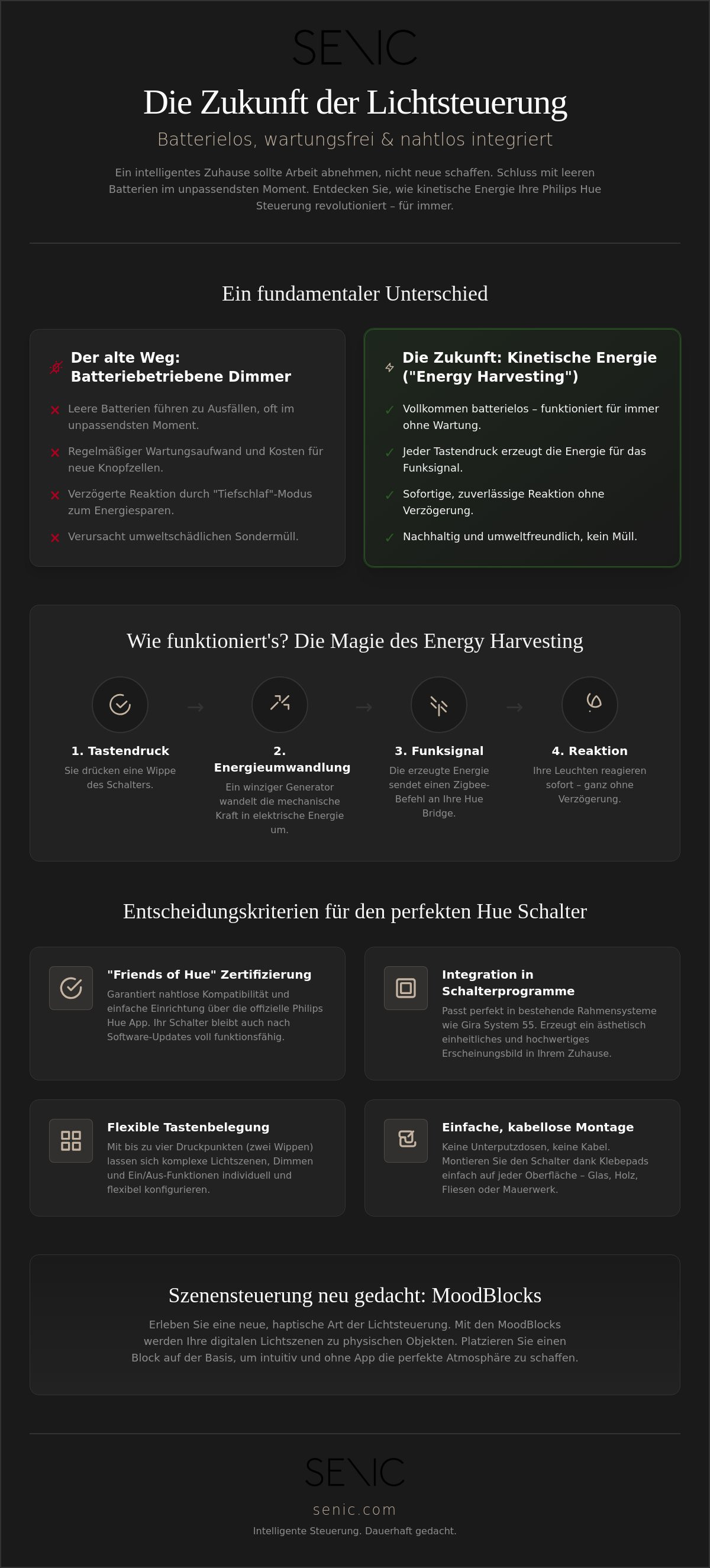
Traditional smart home solutions often encounter an invisible boundary: power supply. A conventional Philips Hue scene switch usually requires batteries. These need to be replaced. They generate special waste. But most importantly, they often fail precisely when they are most needed. Battery-free switches are based on a completely different principle. They use kinetic energy. Every button press generates enough power to send a wireless signal to the bridge. This is the consistent evolution of lighting control. It is a technology that relies on permanence and absolute reliability.
The functionality behind this innovation is called energy harvesting. Inside the housing sits an electrodynamic energy generator. When you press the rocker, this tiny mechanism converts the mechanical force of your finger into electrical energy. This energy is sufficient to send a precise Zigbee command. The Philips Hue system receives this impulse immediately. There is no standby mode. There is no delay caused by waking up dormant electronics. Your lights react instantly. It is technology that simply works, without ever demanding attention in the form of maintenance.
What does Friends of Hue certified mean?
Not every switch on the market is suitable for the Hue ecosystem. The "Friends of Hue" seal is an important quality promise. A Philips Hue scene switch certified in this way guarantees seamless communication with the Hue Bridge v2. Integration is incredibly easy. You use the official Philips Hue app to add the device. The switch is immediately recognized as an accessory. You can assign each button individually. Whether you want to activate a relaxed evening mood or switch off all lights when leaving the house; the configuration remains flexible and intuitive. This certification ensures that software updates to the Bridge do not affect the functionality of your switch.
Kinetic Energy vs. Battery: The Reliability Check
Battery-powered dimmers have an inherent disadvantage: they have to conserve energy. To maximize battery life, these devices are usually in a deep sleep. In some networks, this leads to sporadic connection interruptions or noticeable latencies. Kinetic switches eliminate this weakness. They are always ready for use because they do not have to manage an internal energy source. For professional installations and demanding users, this maintenance-free operation is the decisive criterion. Once mounted on the wall, the switch remains functional for decades. There is no battery compartment that could jam or corrode. The mechanical components are designed for hundreds of thousands of switching cycles. This saves costs in the long term and conserves valuable environmental resources.
- Complete autonomy through dispensing with batteries and cables.
- No special waste generated by empty coin cells.
- Immediate signal transmission without wake-up delay.
- Permanent functional guarantee without maintenance intervals.
- Easy mounting on glass, wood or masonry thanks to adhesive pad.
Making the Right Choice: What Matters When Buying a Hue Switch
The choice of hardware determines long-term satisfaction in your smart home. A Philips Hue scene switch must not only be technically convincing. It must physically blend into your living space. If you want to avoid cheap plastic looks, pay attention to the material quality and integration into established switch series. It's about the tactile experience with every button press. High-quality components feel valuable and react precisely.
For users who value first-class design not only in hardware but also in their personal or business presentation, Nani Vinken Design as a full-service studio offers tailor-made concepts that combine aesthetics and functionality.
A crucial criterion is the number of controllable scenes. Most kinetic models have two rockers with a total of four pressure points. This not only allows individual lamps to be switched. You can store complex lighting scenarios for movie night, dinner, or the concentration phase in the home office. When buying, make sure that the switch offers enough scope for your individual routines. The configuration should remain flexible so that the system grows with your needs.
Standard size 55mm: Maximum design integration
For many homeowners, visual uniformity is crucial. Nothing disrupts minimalist design more than a colorful mix of different switch shapes on one wall. Switches that are compatible with the common 55mm standard elegantly solve this problem. They fit exactly into the existing multiple frames of most European manufacturers. Whether in matte black, pure white, or anthracite; integration is seamless next to your conventional sockets. This consistency ensures a professional look that makes modern technology invisible. For a particularly sophisticated room design, a look at the high-quality switch solutions from Senic, which embody precisely this design philosophy, is recommended.
Drill-free mounting: Flexibility for tenants and owners
Modern smart home technology doesn't require a construction site. A high-quality Philips Hue scene switch can be installed without a single drill hole. This is an unbeatable advantage, especially for tenants. The back of the switches is designed flat. You simply stick the device on smooth surfaces such as glass, tiles, or wooden furniture. This saves time and protects the building fabric.
- Residue-free removal: When you move out, you simply take the switch with you. The wall remains undamaged.
- Bridging old outlets: You can mount the radio switch directly over an old, unused flush-mounted box.
- Placement as needed: The switch moves to where it is needed; for example, directly next to the sofa or at the kitchen island.
The mechanical stability is not affected by the adhesive mounting. Due to the precise manufacturing, the frames sit firmly and wobble-free. If you prefer a permanent fixation, the base plate can of course also be traditionally attached with screws to a standard flush-mounted box. This flexibility makes the switch a future-proof investment for every living situation.
Friends of Hue Switch vs. Standard Dimmer: A Functional Comparison
The classic Philips Hue Dimmer Switch is a functional entry-level device. However, it remains a compromise between a remote control and a wall switch. A professional Philips Hue scene switch from the Friends of Hue program takes a different approach: permanence. While the standard dimmer relies on a CR2032 battery, the kinetic version works completely autonomously. This not only means less maintenance. It also means an end to searching for replacement batteries at the most inconvenient moment.
Both device types can be configured in detail in the Hue app. The crucial difference lies in physical presence. A standard dimmer often looks like a foreign object on the wall. It breaks the aesthetic of existing switch series. A high-quality scene switch, on the other hand, optically disappears into the architecture of your house. It becomes part of the fixed electrical installation by fitting into common 55mm standard frames, without adopting their disadvantages like complex wiring. In the long term, investing in a battery-free system is more economical, as ongoing costs for batteries and their disposal are eliminated.
- Power Source: Battery-powered (Standard) vs. Kinetic (Friends of Hue).
- Design: Standalone housing vs. integration into 55mm standard frames.
- Mounting: Magnetic holder vs. fixed adhesive or screw mounting.
- Sustainability: Regular battery waste vs. lifelong, maintenance-free use.
Haptic Feedback and Switching Feel
The switching feel of a kinetic switch differs significantly from the soft rubber of a standard dimmer. When you press a Senic switch, you hear and feel a characteristic click. This mechanical feedback confirms the successful switching process. It is reminiscent of the solidity of classic light switches. The pressure points are precisely defined. This prevents incorrect operation and ensures intuitive control of your Philips Hue scenes. While original accessories often feel like a light plastic remote control, the robust mechanics of kinetic switches convey quality and durability.
Outdoor Use: The Single Outdoor Switch
Smart lighting doesn't end at the patio door. For control in the garden or on the balcony, the standard dimmer is unsuitable because it is not weatherproof. This is where the Single Outdoor Switch plays to its strengths. This model is specially designed for harsh outdoor conditions. It defies rain, snow, and direct UV radiation without fading or becoming brittle.
Imagine controlling your garden lighting directly from the barbecue station. With a robust Philips Hue scene switch for outdoors, this is no problem. It requires no flush-mounted box and no cables. You simply mount it on the house wall or on the garden shed. The range is stable even outdoors thanks to Zigbee mesh technology, as each Hue lamp forwards the signal. This means that lighting control is always at hand and reliably protected at the next garden party.
The MoodBlocks Collection: Scene Control on a New Level
Choosing light scenes via an app is functional. Experiencing them haptically is a completely new form of interaction. The MoodBlocks (also called Muse Blocks) expand the concept of the classic Philips Hue scene switch with a physical component. Instead of just pressing buttons, you use artfully designed objects to activate complex lighting moods. It is the symbiosis of analog haptics and digital precision. This innovation makes smart home technology tangible and transforms control into an aesthetic ritual.
The range currently includes 27 different designs. Each piece is unique in its visual effect. To introduce this new way of controlling, you benefit from a special offer. If you choose three blocks, you get the fourth one for free. This "Buy 3, Get 1 Free" promotion allows you to furnish different rooms with matching moods simultaneously or to create a varied gallery on your wall. It's the ideal way to test the versatility of haptic scene selection without risk.
What are MoodBlocks and how do they work?
The technology behind MoodBlocks is as simple as it is ingenious. Each block contains an integrated NFC chip. In combination with the special Senic hardware, simply placing or touching the block is enough to trigger the stored scene. The system immediately recognizes the object and communicates with your Hue Bridge without delay. The wall mount not only serves as a technical contact point. It functions as a functional work of art in the room. You can present your favorite scenes like in a small gallery and simply exchange the blocks as needed. It's the perfect solution for anyone who wants to integrate technology invisibly but effectively into their interior.
Buying Guide: Which Muse Blocks match your style?
The selection of the right blocks largely depends on the atmosphere you want to create in your living spaces. The designs are as diverse as the light scenes themselves. For the bedroom, soft color schemes and organic patterns that exude tranquility are recommended. In the home office, on the other hand, clear lines and high-contrast motifs support concentration. Combine different blocks to tell a visual story on your wall. Discover the new MoodBlocks collection now and find the perfect addition to your individual home design.
- Intuitive operation: No searching in apps, no confusing buttons.
- Aesthetic added value: High-quality design objects instead of technical controls.
- Flexibility: Scenes can be physically reordered by simply exchanging the blocks.
- Collectibility: Expand your collection to match new interior styles or seasons.
- Creative Addition: If you enjoy individually customizable physical accessories beyond lighting control, check out Buttons.ch and discover high-quality personalized buttons and magnets.
Installation and Setup: How to Seamlessly Integrate Your Senic Switch
Setting up a modern Philips Hue scene switch takes only a few minutes. Since the hardware requires no cables or batteries, there's no need to chisel into walls or fuss with terminal blocks. You can focus purely on digital configuration. This simplicity reflects the core of modern smart home philosophy: technology should serve, not hinder. Once the switch is physically placed, the app takes care of the rest.
Ready in 2 minutes: The pairing process
To utilize full functionality, a Philips Hue Bridge v2 (the square version) is absolutely necessary. Open the Philips Hue app and navigate to the accessory settings. Select "Add new Friends of Hue switch." The app will guide you through a short process where you press specific button combinations on the switch. The system will immediately recognize the device. Afterward, you assign the pressure points. You decide which rocker controls which lamp group or activates which scene.
A technical advantage is the Zigbee mesh network. Every permanently installed Hue lamp acts as a signal amplifier. Briefly test the range after pairing. Since the switch requires no energy for standby mode, the connection is extremely stable. If the switch doesn't respond immediately in a certain spot, placing a smart lamp halfway to the Bridge often helps.
Extended scenes with Apple HomeKit
The Senic switch is not limited to the Hue universe. By integrating it into Apple HomeKit, you massively expand its range of action. In the Apple Home app, the switch appears as a programmable accessory. This allows you to control devices from other manufacturers with a Philips Hue scene switch. Pressing a button can, for example, simultaneously dim the lights, start the Sonos speakers, and close the smart blinds.
- "Good Night" Routine: With a single press next to the bed, turn off all lights in the house and lock the front door.
- Central Departure: Place a switch at the apartment door to deactivate all unnecessary power consumers when leaving.
- Commercial Use: Use the stable automations for offices or exhibition spaces.
Conclusion: The perfect switch for your home
Choosing a kinetic Friends of Hue switch is a decision for longevity and aesthetics. You eliminate the frustration of dead batteries and unfitting designs. The seamless integration into the Gira System 55 ensures a calm, professional room appearance. For a uniform design throughout the house, the Double Indoor Pack or the Triple Indoor Pack are ideal. This ensures that every room follows the same high standard of operating comfort. Upgrade your Smart Home with the new MoodBlocks and experience how haptic elegance enriches your everyday life.
The future of light control is maintenance-free
The choice of the right control determines daily comfort in your home. A kinetic Philips Hue Scene Switch offers you the certainty that your lighting moods are always ready; without annoying battery changes or complex wiring. Thanks to official Friends of Hue certification and compatibility with the common 55mm standard, this technology seamlessly integrates into your architecture. It is the combination of technical reliability and minimalist aesthetics that simplifies your everyday life instead of burdening it with maintenance tasks.
With the introduction of haptic elements such as MoodBlocks, interacting with your Smart Home becomes a completely new, tangible experience. Design your lighting control as individually as your interior and opt for a solution designed for longevity. It's time to let technology work for you, instead of constantly having to maintain it.
Discover the MoodBlocks collection now and get the 3+1 Free advantage. Prepare your home for intelligent lighting that simply works.
Frequently Asked Questions
Does the Senic Friends of Hue switch really require no batteries?
Yes, the switch operates completely battery-free and self-sufficiently. It uses so-called energy harvesting technology, where the mechanical energy of your button press is converted into electrical current. This energy is sufficient to reliably send the Zigbee radio signal to your Bridge. So you never have to change batteries or worry about disposing of button cells, which makes the switch absolutely maintenance-free.
Can I use the switch with any Philips Hue bulb?
Yes, you can control any light source that has been successfully integrated into your Philips Hue system. Since the Philips Hue Scene Switch communicates directly with the Hue Bridge, all connected lamps, light strips, and outdoor lights can be addressed. It doesn't matter whether they are White, White Ambiance, or Color variants. You simply assign the desired lamps to the corresponding buttons in the official app.
Is the switch compatible with Apple HomeKit?
Yes, the switch is fully compatible with Apple HomeKit via the Philips Hue Bridge v2. Once the device is set up in the Hue app, it automatically appears as a programmable accessory in the Apple Home app. There you can use it to trigger complex automations that also include devices from other manufacturers. This way, you control lights, thermostats, and speakers with just a single button press centrally.
How many scenes can I save on one switch?
By default, you can assign four different scenes or actions to the four pressure points of the switch. Each button can be individually configured, for example, to activate a specific lighting mood or to turn off all lights. By using third-party apps like iConnectHue, it is technically possible to significantly expand the number of actions through multiple assignments or long presses. This offers you maximum flexibility for your daily smart home routines.
Can I install the switch in my existing Gira frames?
Yes, the switch has been explicitly developed for the Gira System 55 and fits perfectly into its frames. You can easily insert the module into existing multi-frames next to your conventional sockets or light switches. This ensures an aesthetically uniform and professional appearance on your walls. The integration is seamless and without visual breaks, as the design is precisely matched to the established switch ranges.
What happens if the Philips Hue Bridge has no internet connection?
The basic functions of your lighting control remain fully intact even without an active internet connection. Since the communication between the Philips Hue Scene Switch, the Bridge, and the lamps occurs locally via the Zigbee protocol, switching and dimming continue to function reliably. Only cloud-based functions such as remote control from outside the home or software updates are temporarily restricted. Your local system thus remains operational at all times and independent of the online status.
How does the "Buy 3, Get 1 Free" promotion for MoodBlocks work?
The promotion is automatically applied in the shopping cart. If you add four MoodBlocks of your choice, the price of the fourth block will be deducted directly. You only pay for three items and receive the fourth as a free addition. This is the ideal opportunity to equip different living areas with individual haptic scenes or to create a varied design gallery on your wall, without additional costs for the fourth block.
Can the switches also be used in the bathroom (damp room)?
The indoor models are suitable for use in normal living spaces, including bathrooms. As long as the switch does not come into direct contact with splashing water, the usual humidity does not affect the kinetic mechanism. However, for areas with direct exposure to weather or very high humidity, we recommend the Single Outdoor Switch. This has the necessary IP certification and more robust materials to be permanently protected against external influences.